
From California to Hawai’i and back again: The birth, rise, and survival strategy of an mCDR startup
Travel over 2,000 miles, or 3,200 km out from the continental US and you will find a curious stretch of American entrepreneurship in the middle of the Pacific Ocean. The westernmost edge of Hawai’i’s Big Island is home to shellfish producers, renewable energy developers, and a marine mammal sanctuary, all under the leadership of Hawai’i Ocean Science and Technology Park. The physical site, led by the state government, is broadly tasked with diversifying Hawai’i’s economy, but the latest newcomer to this community pushes its conceptual boundaries into new terrain – a company out to prove it can capture CO2 from the ocean and store it deep underground, to help tackle climate change.
The startup, California-based Captura, was born in 2021. It was one of hundreds globally, all launching into a newfound race to prove a better, faster, cheaper method of CO2 removal (CDR). The starting gun was fired when the world’s top climate scientists at the Intergovernmental Panel on Climate Change agreed that CDR – by land, air, or sea – is essential to limit global warming. This spawned an industry that in 2023, global consultancies predicted could grow to be worth a trillion dollars by 2050.
Hundreds of companies have sold investors on a vision of capturing CO2 by the tonne and selling the resulting carbon credits to buyers committed to a net zero goal. For all involved, it’s a pledge to climate action and a bet on new and emerging methods of carbon removal. The earliest investors believed that enough buyers would purchase enough credits for their investees to ultimately generate revenue and deliver some return on investment.

Captura’s 100-tonne-per-year pilot system at AltaSea at the Port of Los Angeles. Credit: Captura
Five years on, the market has spoken, and global events have reshaped the climate agenda. The US officially exited the Paris Climate Agreement on Jan. 27. Multinational companies are pulling back from their net zero emissions goals. Governments the world over are focused on energy sovereignty and artificial intelligence, rather than addressing climate change. In a 2025 survey of energy policymakers, investors, and businesses, 80% of respondents ranked energy security ahead of GHG emissions when it comes to energy innovation.
For Captura, its continued existence depends on selling something other than carbon removals, at least for now.
The good old days
Captura is among the class of marine carbon removal (mCDR) companies that use the ocean to capture or store CO2, in contrast to land- or air-based methods. Per unit of volume, seawater holds nearly 150 times more CO2 than air.
Spun out of a lab at Caltech, Captura began its operations in 2023 on a barge off the Californian coast to demonstrate that it could remove 1 tonne of CO2, and then 100 tonnes of CO2 from seawater. At the Port of Los Angeles, the company’s R&D team fixed metals and plastic together to build the first units that could capture CO2 from the ocean.
One of the company’s early interns was Angelica Rippee, a marine biology student at the University of Hawai’i. The role was well-suited to her interdisciplinary experience from other science and technology internships.
“It was kind of messy, but that’s part of R&D,” Rippee tells Carbon Pulse today. It was perhaps to be expected for a startup testing its technology out of lab for the first time, let alone on a floating vessel. At some points, she found herself entering and exiting the barge with the sea at high tide, suddenly at her feet, threatening to flood the pilot carbon removal system.
The barge was operated by the port’s ocean technology hub AltaSea, where Captura found itself in the company of other ocean innovators. That included mCDR competitor Equatic, a UCLA spinout, which was testing similar technology on the same vessel. Both companies use electricity to split seawater into acid and base, but they each proceed with carbon removal in distinct forms. Equatic uses the base to react with and remove atmospheric CO2 in solid form, while Captura adds the acid back to seawater, which allows for a vacuum to directly extract the CO2 in gaseous form.
The two companies effectively elbowed for space to prove their nascent technologies – both on the barge and beyond, competing for capital and ultimately, credibility. But in terms of R&D, they both ended up a success, in the sense that they sold their visions to investors. In 2024, Equatic announced it was taking its technology to scale in Singapore, where it would build a larger demonstration project with the backing of the country’s water agency, capable of capturing 3,650 tonnes of CO2 a year. The same year, Captura raised $45.3 million in Series A funding and announced it would grow its 100-tonne-per-annum system at AltaSea into a 1000-per-annum system at the Hawaii Ocean Science and Technology Park in Kona, Hawai’i.
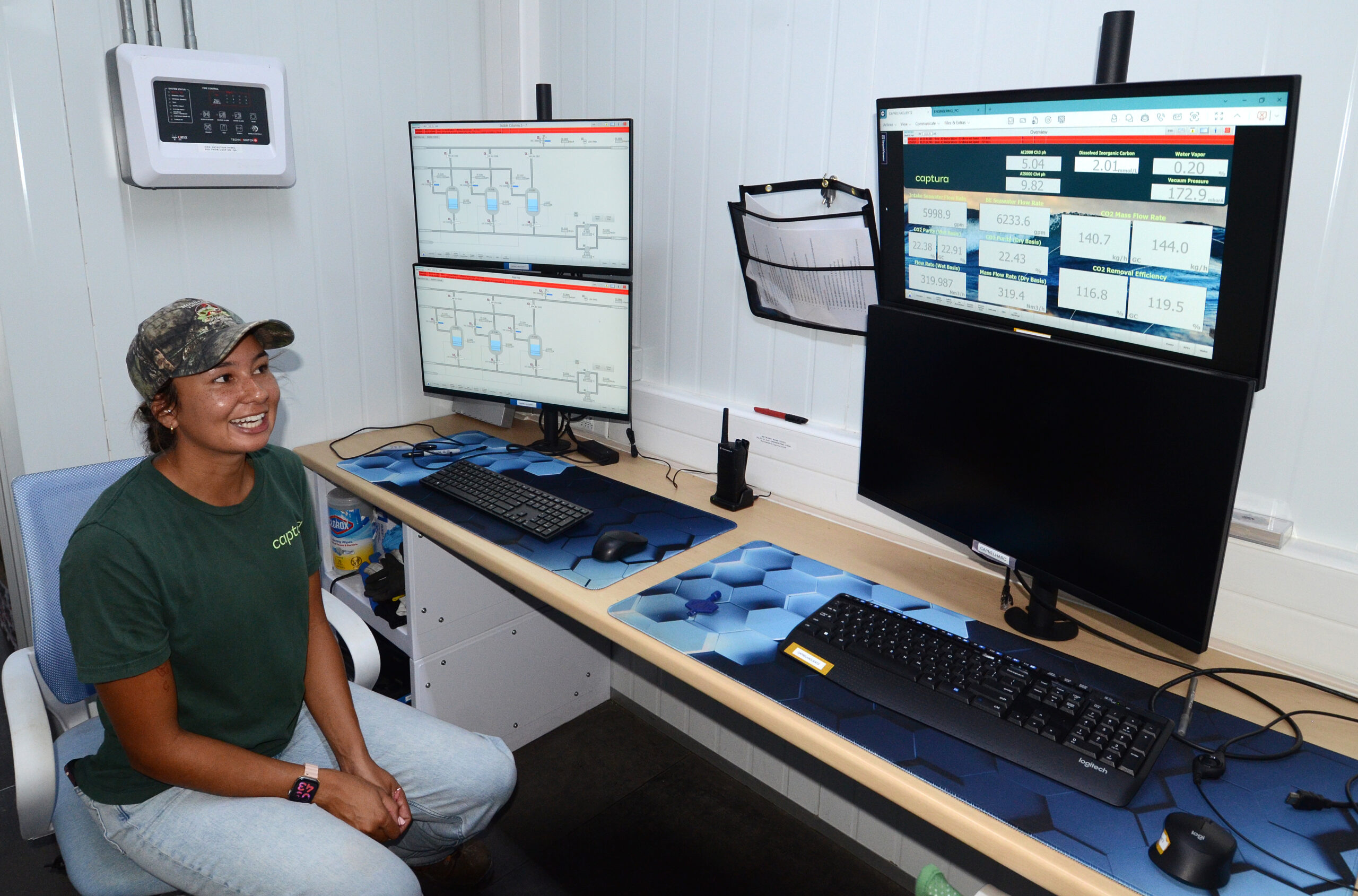
Captura’s Site Engineering Lead Angelica Rippee monitors operations from the control room. Credit: Laura Ruminski
Rippee graduated and joined Captura full-time in California in 2023. In early 2025, commissioning of the Hawai’i facility began, and she moved back to the state to help lead operations on-site. It was initially abuzz with staff who had also worked on the smaller pilots in Los Angeles, and now used their knowledge to run similar tests and experiments on the island system. But 18 months later, there are just two employees left at the facility: Rippee and Brian Standley, an electronics engineer.
These two oversee the larger pilot facility, which is plugged into a pump that draws in seawater from the ocean. Some of this incoming seawater flows through Captura’s electrodialysis unit to produce acid and base, the chemicals that ultimately enable the removal of CO2. Most of the seawater flows into a series of structures where CO2 can be vacuumed out in gaseous form. In these structures, known as degassing columns, the aforementioned acid is mixed with the seawater to strip out the CO2. The resulting lightly acidic seawater is then neutralised with base, before being returned to the ocean.
It’s a largely automated process unique to Captura that Rippee, as site engineering lead, helped to refine along with a whole team of staff at the height of the company’s operations.
Some of the experiments took days. Rippee and a colleague once worked for 11 days straight, with the goal to collect enough data to prove the facility could remove 1,000 tonnes of CO2 a year, under continuous operation.
“We would come here for 12 hour shifts and stay overnight, delirious, looking at the control interface… if something would go wrong at 3AM we’d be out there with headlights on, trying to fix stuff,” she said.
By the end of the 11 days, Captura had more than enough data to confidently say that it could remove 1,000 tonnes of CO2 a year.

Captura extracts CO2 from the seawater off the Kona coast, Hawai’i. Credit: Laura Ruminski
Reality check
Hawai’i was a perfect fit for a 1000-tonne pilot plant, CEO Steve Oldham told Carbon Pulse in May – except that there was nowhere to store the captured CO2.
At present, the CO2 that Captura removes in Kona is either vented into the air – for safety reasons, staff say – or shared with other partners at the park for use in lieu of imported CO2. Oldham said Captura could sell the captured CO2 on the island, especially as it’s expensive to ship in the gas. But Captura counts some of the world’s largest emitters amongst its backers, including national oil company Saudi Aramco, Norwegian energy giant Equinor, and Danish shipping major Maersk. These investors have emissions reduction targets and their interest in Captura is ultimately driven by its promise of removing their pollution from the atmosphere.
“Some of them recognise that climate is going to be a regulatory issue for them in the future,” said Oldham. “Even if that regulation isn’t in place today […] you want to have thought about it well in advance.”
“Then you have ones that look at this as more of an opportunity: can I use the core competencies, skills, and infrastructure my business has to pivot a little bit to offer carbon removal?”
For Katherine Peachy, head of Equinor Ventures, both reflections are relevant when it comes to its investment in Captura, particularly as its leading investor. Her team is focused on generating financial returns for Equinor over time, but is also looking to generate “strategic value” for the energy major, which is still largely a fossil fuel-based business.
“We [Equinor Ventures] are responsible for investing in early and growth stage companies that are developing technologies and business models for the future of energy systems – and which may be relevant for Equinor in the future,” she told Carbon Pulse.
“We are very focused on the energy transition and the technologies that we think are needed in the energy transition,” she added. “Captura is a really interesting company for us because we think it’s got the potential to build at scale.”
Going to scale
For Captura to conduct carbon removal in the full sense – that is, both the capture and storage of CO2 – it would need to build another plant with the transport and storage infrastructure to boot. Storage of CO2 deep underground requires particular geology that its 1,000-tonne pilot plant in Hawai’i did not have.
Oldham was frank that the company has not yet found the capital needed for this. While it’s been active in scouting out storage sites worldwide, a key enabler would be an offtake agreement, he said, where a buyer agrees upfront to purchase a certain volume of carbon removals. Captura has secured one, a 30,000 carbon credit deal with Japanese shipping company Mitsui O.S.K. Lines. But Oldham is looking for another offtake agreement of at least 35,000 tonnes to support the financing of its next, commercial-scale facility.
So far, no investor has stepped forward to seal a deal at that scale, and Oldham does not see any doing so soon, especially in the wake of tech giant Microsoft, the carbon removal industry’s chief buyer to date, recently pausing its purchases. There is no regulatory scheme that mandates governments or companies to purchase carbon removals to date.
Captura is not the only mCDR company that has yet to demonstrate material removals. Equatic, Captura’s Altasea neighbour at the Port of Los Angeles, had its Singapore demonstration plant slated for commissioning in 2024. However, the facility was not yet operational at the time of publication.
For some companies, it has become an existential crisis. In June, Dutch mCDR company SeaO2, which pursued a form of direct ocean CO2 capture similar to Captura, declared bankruptcy. It too, had raised millions to bring its technology out of the lab and into the sea – before the tides turned.
“Capital locked up. We pursued investors at home and abroad, across Europe and beyond. Private investors waited for public commitments. Public players waited for private ones. And so no one moved. We fought like lions. We tried every conceivable scenario. But last week, we had to tell our team, with tears in our eyes, that the money has run out,” the company said on LinkedIn in late May, in a final effort to acquire funds, just weeks before it declared game over.

Captura’s degassers at its 1000-tonne-per-year pilot plant in Hawai’i, which remove CO2 from seawater. Credit: Laura Ruminski
Patience thins
In 2025, Akash Rastogi came out of retirement from a decades-long career in banking and capital markets to work on oceans and climate change, including mCDR, for his daughter and the next generation. he joined Canada’s Ocean Supercluster – an industry-led, federal government-funded initiative focused on the commercialisation of ocean-based solutions – as its chief capital strategy officer.
“If mCDR is ultimately not done at scale, then it’s just a science experiment,” Rastogi told Carbon Pulse in an interview in May.
A major roadblock to scaling mCDR is the limited pool of accessible and fit-for-purpose funding to make the leap to commercialisation, he explained. mCDR technology is not well-suited to “traditional” investors like venture capital firms who prioritise financial returns over a relatively short time horizon.
mCDR companies need more patient capital at the innovation stage, from institutions like philanthropies or governments that are willing to wait years before they see returns, if at all. But even that can only take a startup so far, Rastogi cautioned. Patient capital will not get a company through the five to 10 years of business after the early stages.
“In mCDR, I see that most people tend to be climate warriors and business is an afterthought. That needs to be flipped,” he told Carbon Pulse.
Captura’s CEO is perhaps among the more pragmatic and business-minded of CDR founders. Captura is Oldham’s second CDR venture, having first joined direct air capture (DAC) company Carbon Engineering as CEO in 2018. Just one year after he joined, the company raised $68 mln in equity financing, with participation from the venture capital arms of major US oil and gas firms Chevron and Occidental Petroleum.
Carbon Engineering, under Oldham’s leadership, spent the next few years fine-tuning its technology and commercial partnerships. It later entered into a strategic partnership with Occidental Petroleum to deploy DAC together in Texas, building a facility that was slated to capture 500,000 tCO2 each year. That set the stage for Carbon Engineering’s acquisition by the oil giant for $1.1 billion in 2023. To date, this is the only acquisition of its size in the carbon removals industry.
But not all are convinced that private companies are the best route to scaling mCDR. David Ho, a professor of oceanography at the University of Hawai’i at Manoa, was part of early mCDR research efforts both within and beyond academia. Ho is an established researcher in ocean science key to the veracity of the field, but he also co-founded a non-profit organisation in 2023 to build software that supports mCDR research.
Ho thinks that the field should be a government-funded or government-run research effort, not driven by companies via venture capital and private funding.
“There’s so much that we need to figure out that companies are not going to do. They are there to work on their [own, specific] technology,” he said.
Ho pointed to areas of research essential to scaling mCDR – in the realms of environment, geophysics, governance, and social studies – that companies are not necessarily prioritising.
“They’re not thinking about that. It’s ‘How do you develop intellectual property that you can maybe sell to a fossil fuel company?’ I bet every single one of them looks at the exit that Carbon Engineering took and says ‘Well, we too would like to get $1 bln.’ And that’s the best exit for any of them right now, because they will never be paid billions of dollars to remove carbon.”

Captura’s electrodialysis system at its pilot plant in Hawai’i. Credit: Laura Ruminski
Shopping around
As of late 2025, direct ocean capture credits had an average price of $1,100 apiece. At Captura, Oldham says his focus is to drive down its cost base and prove the company’s technology at scale through other markets, such as lithium extraction, desalination, and wastewater valorisation. Oldham did not disclose specifics of precisely how much he will need to bring down the cost of Captura’s technology by to attract more finance for mCDR applications.
“From our perspective, the case for carbon removal isn’t really a question. It’s needed for a credible net zero pathway,” Equinor Ventures’ Peachy told Carbon Pulse.
“The real question is, what technologies can do it efficiently and affordably, and what companies can survive long enough to get to the time when it really scales up and the market really opens up for it?” she added.
“Captura is a really interesting company for us because we think it’s got the potential to build at scale.” -Katherine Peachy, head of Equinor Ventures
Today, Captura is raising funds as part of its Series B, even as Oldham recognises the company is unlikely to be selling large-scale removals anytime soon. So, in parallel to pursuing CDR credits, Captura is trying to sell its electrodialysis technology – the equipment that produces the acid and base components central to its mCDR process – into other industrial markets.
One of those is long-term energy storage, an appealing sector because of growing data centre demand for energy, Oldham said.
“Electrodialysis can do that for you. We take excess renewable energy, run it through our electrodialysis, and then you produce acid and base. That’s just two big tanks, easily stored. Then when you want energy back, you run the acid and base through the same electrodialysis device, and you regenerate the renewable energy. So you’ve basically turned your facility into a big battery,” he said.
AI companies face criticism for their carbon footprint, but struggle with the variability of renewable energy as a low-carbon option to power their operations. On the flip side, renewable energy providers are often forced to curtail surplus energy that cannot be absorbed by the grid. If Captura could sell a cost-effective energy storage solution, it could offset the near-term turbulence in the nascent CDR market, Oldham said.
“I actually see that our business will be products-based in the next two, three, four, five years, while we grow momentum in CDR and demonstrate to the world, the public, the regulators, the offtakers, that there are credible solutions at scale and at low-cost. Meanwhile, our bills are being paid by products.”
It’s a strategy that appears to appease Captura’s leading investor.
Equinor Ventures, which led Captura’s Series A of $45.3 mln, returned to lead its Series B, which announced its first close at $12.5 mln in late June.
“We strongly believe we need to help companies be ready for when those [carbon] markets really open up, and that’s why we’ve invested in Captura. We don’t need the markets to work on day one for Captura,” said Peachy.
“Most carbon removal companies are waiting for the market to arrive […] but we see that Captura is building the engine in the meantime. Every time it sells a stack [of electrodialysis technology], direct ocean capture becomes cheaper,” she added.
At one point in time, society did not appear too far off from paying for carbon removal. Governments started putting their money on the table, committing to early purchases. In 2022, the US Department of Energy announced $35 mln in awards that would eventually lead to the purchase of CDR credits. But the funding largely focused on DAC pathways, and many of those grants were frozen once President Donald Trump re-took office in 2026.
Still, that funding was a far stretch from mandating entities to pay to remove CO2 from the atmosphere. Even nations with more political appetite for climate action have not implemented schemes of the sort. In Canada, where Oldham is based, an adjacent approach to addressing emissions – a carbon tax applied to fossil fuels – was eliminated the first day Prime Minister Mark Carney took office in 2026. The tax had survived seven years, but was scrapped amid concerns over inflation and energy affordability.
At some point in time the world may require companies to pay to remove large volumes of CO2 from the atmosphere, particularly via the ocean. “I hope we will be there with a really good solution when the world realises it’s a problem that needs to be solved,” said Oldham. “But if a whole bunch of companies are not [there anymore], we’re going to arrive at this horrendous situation where we suddenly realise we need to solve the problem and there’s nothing available to solve it.”
By Allison Gacad – [email protected]
This piece was supported by the Pulitzer Center, where Allison spent four months on a grant from Feb. to June 2026 investigating mCDR.