

By Ingrid Thyr (Yale), Ethan Belair (TNC), Lisa Sheridan (Yale), Caroline Stetson Dibble (Yale), Savannah Gupton (Yale)
Addressing uncertainty in leakage accounting for nature-based carbon crediting is critical for bolstering confidence in carbon crediting protocols. Researchers from the University of Maine, the Ohio State University, and The Nature Conservancy addressed this need by developing a novel data-driven approach to estimate leakage created by individual forest carbon projects. Their research, published last year in Environmental Research Letters, suggests that leakage of carbon emissions from improved forest management projects largely depends on several readily measurable variables and may be lower than previously estimated. These findings could allow project developers to mitigate leakage risk through project design and strengthen leakage estimates, enhancing integrity of forest carbon credits and increasing confidence in carbon markets as a tool for climate action.
Leakage refers to the displacement of carbon emissions to outside the boundaries of a forest carbon project area. If a forest carbon project simply shifts emissions to another place rather than reducing them, it is not producing the desired real climate benefit of keeping carbon out of the atmosphere. For example, if a forest carbon project delays or eliminates a timber harvest but demand for wood products remains the same, some portion of the products that would have been produced (as well as the associated carbon emissions) will still be produced from additional harvesting elsewhere. Leakage is a pressing integrity issue in the voluntary carbon market, with some concerned that current practices underestimate leakage potential in forest carbon projects, which would mean that projects risk generating fewer net climate benefits in reality than claimed on paper.
All major forest carbon credit methodologies require leakage estimates when calculating credits generated from a project, but many have different approaches for estimating leakage. Typically, leakage is “deducted” from the emissions reductions a project creates, using a standard percentage that varies according to basic project characteristics. The standard deductions used in crediting protocols typically range from 10% to 40%, though some studies have estimated leakages as high as 70%. This method of accounting for leakage with standard deductions is quite coarse and means that project protocols are often designed with little reliable information about how these decisions may affect leakage risk. “Estimating potential leakage for individual carbon mitigation projects is one of the most poorly understood elements in crediting protocols,” said Ethan Belair, senior forest carbon scientist at The Nature Conservancy. Coarse methods for approximating leakage hamper carbon markets in both directions: overestimating leakage causes legitimate climate benefits to go uncounted, while underestimating leakage allows a project to issue more carbon credits than were truly produced.
This research advances leakage estimation for improved forest management projects by applying a dynamic economic-ecological modelling approach that more accurately models how forest ecosystems and timber markets interact over time. Unlike many previous studies, which focused primarily on harvest displacement, the model explicitly incorporates both market and activity-shifting leakage. Market leakage occurs when reduced timber supply from a project affects forest product prices and/or land prices and induces changes in management by landowners outside the project area. Activity-shifting leakage refers to local shifts in harvesting practices due to a forest carbon project. Analytically, the study treats activity-shifting leakage as a subset of broader market responses, allowing both mechanisms to be evaluated consistently across ownerships and regions. Importantly, the analysis moves beyond conventional harvest leakage metrics to estimate carbon leakage directly, revealing that changes in harvest volume do not necessarily translate into proportional carbon impacts and, under some circumstances, can produce net beneficial carbon spillovers.
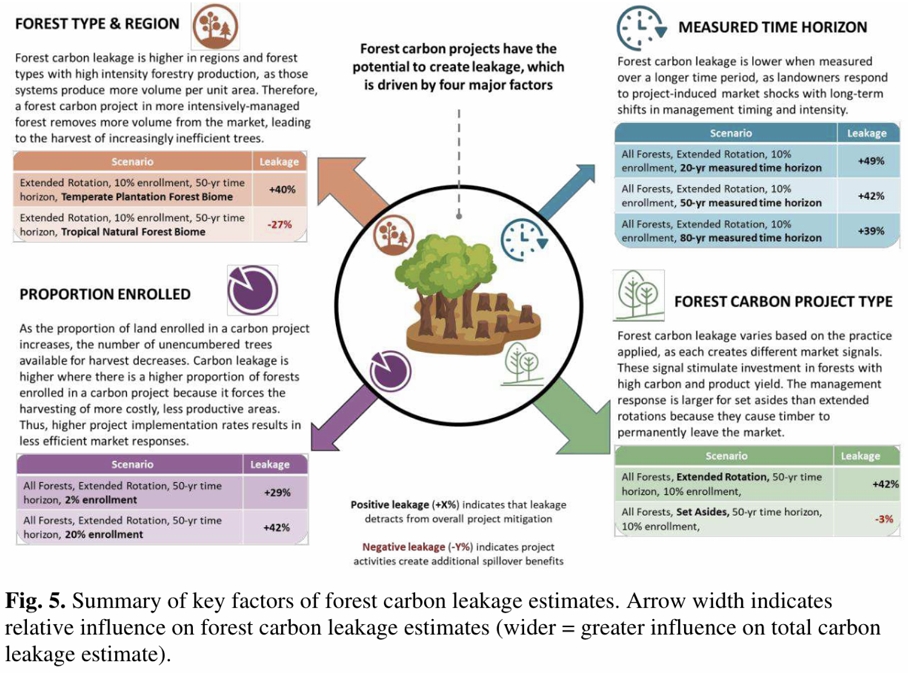
Researchers generated carbon project scenarios that varied by forest type, project implementation rate, and project type, and used the Global Timber Model to estimate the resulting forest carbon leakage at regional scales. These results were then scaled to create a global set of leakage rates for all forests for extended rotations and permanent forest protection, showing how leakage outcomes are most likely to vary across different regions.
The study finds that leakage is often considerably lower than expected, rarely exceeding 50% of a project’s emissions reductions. In some cases, particularly in tropical regions and set-aside projects where timber harvesting is permanently halted, leakage is negative, such that a project creates a positive spillover effect and generates more net climate benefits than what is strictly accounted for within the project’s accounting boundary. An example of a positive spillover effect could be if a landowner sees timber prices increase when several forest carbon projects in their region intentionally delay timber harvest and then decides to enter this market by converting their marginal agricultural land into timber plantations. That landowner’s action is influenced by the market demand for different commodities like timber and pulp, and we can assume the landowner was induced to plant additional areas of forests based on the market signals resulting from forest conservation.
This analysis also revealed that leakage rates are highly dependent on project characteristics and cannot be accurately represented by a single default value. The most important drivers of leakage in this model were project type, forest type and region, project implementation rate, and time horizon. These findings underscore the importance of incorporating project-specific conditions into leakage assessments to improve the accuracy of forest carbon accounting.
This research is already being used to create an applied accounting tool for project developers that provides more accurate estimates of carbon leakage based on their individual project specifications. That accounting tool will also include leakage mitigation accounting, to enable project developers to take additional actions that reduce the leakage their project creates. The researchers expect that their approaches will also be relevant to forest carbon interventions beyond improved forest management and plan to adapt their leakage accounting framework for REDD+, as well as explore applications in non-forest settings.
This research was the initial focus of the Leakage Working Group within the Science for High Integrity Frameworks to Transform Carbon Markets (SHIFT-CM). SHIFT-CM is an established network of carbon markets researchers convened by The Nature Conservancy and the Yale Applied Science Synthesis Program to address gaps in the scientific literature around Natural Climate Solutions accounting. Since the publication of this initial body of work, the SHIFT-CM leakage working group has expanded to include leading scientists and practitioners from more than 20 organisations working across a variety of carbon market roles.
Noted research attributed to following researchers: Ethan Belair, Senior Forest Carbon Scientist at The Nature Conservancy, Adam Daigneault, Director of the University of Maine’s School of Forest Resources, Dr. Brent Sohngen, Professor at the Department of Agricultural, Environmental, and Development Economics at Oregon State University, and Peter Ellis, Global Director of Natural Climate Solutions Science at The Nature Conservancy
Any opinions expressed in this commentary reflect the views of the authors and not of Carbon Pulse.
Carbon Pulse allows subscriber companies to submit one piece of ‘Contributed Content’ (op-eds, advertorials, tenders/RFPs, etc) per year. This post appears in front of our paywall, so it’s readable by anyone. It also appears in our CP Daily newsletter once. Beyond that, or for non-subscribers, we allow companies to purchase ‘Sponsored Posts’. These posts also appear in front of our paywall, while we feature them in our daily newsletter for three consecutive days (instead of one).
You can read more about our Contributed Content/Sponsored Post offering here: https://carbon-pulse.com/advertising-brochure/